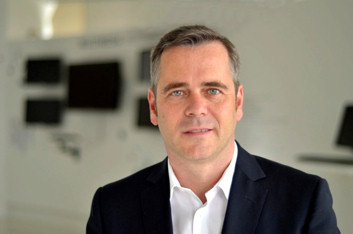
This photo is licensed under CC BY 4.0.
Thomas Wiegand is a professor in the department of Electrical
Engineering and Computer Science at the Technical University of Berlin
and is jointly heading the Fraunhofer Heinrich Hertz Institute, Berlin,
Germany. He received the Dipl.-Ing. degree in Electrical Engineering
from the Technical University of Hamburg-Harburg, Germany, in 1995 and
the Dr.-Ing. degree from the University of Erlangen-Nuremberg, Germany,
in 2000.
As a student, he was a Visiting Researcher at Kobe University, Japan,
the University of California at Santa Barbara and Stanford University,
USA, where he also returned as a visiting professor. He was a consultant
to Skyfire, Inc., Mountain View, CA, and is currently a consultant to
Vidyo, Inc., Hackensack, NJ, USA.
Since 1995, he has been an active participant in standardization for
multimedia with many successful submissions to ITU-T and ISO/IEC. In
2000, he was appointed as the Associated Rapporteur of ITU-T VCEG and
from 2005-2009, he was Co-Chair of ISO/IEC MPEG Video.
The projects that he co-chaired for the development of the
H.264/MPEG-AVC standard have been recognized by an ATAS Primetime Emmy
Engineering Award. He was also a recipient of a ATAS Primetime Emmy
Engineering Award for the development of H.265/MPEG-HEVC and a pair of
NATAS Technology & Engineering Emmy Awards. For his research in video
coding and transmission, he received numerous awards including the
Vodafone Innovations Award, the EURASIP Group Technical Achievement
Award, the Eduard Rhein Technology Award, the Karl Heinz Beckurts Award,
the IEEE Masaru Ibuka Technical Field Award, and the IMTC Leadership
Award. He received multiple best paper awards for his publications.
Since 2014, Thomson Reuters named him in their list of “The World’s Most
Influential Scientific Minds” as one of the most cited researchers in
his field. He is a recipient of the ITU150 Award. He has been elected to
the German National Acdemy of Engineering (Acatech) and the National
Academy of Science (Leopoldina).
Since 2018, he has been appointed the chair of the ITU/WHO Focus Group on Artificial Intelligence for Health.